Image

 Patient Care
When you think of a radiologist, you probably picture a doctor sitting in a dark room, looking at X-rays, CT scans, or MRIs. While finding diseases on a screen is a big part of medicine, another exciting branch of this field goes far beyond just reading images. It is called interventional radiology (or IR for short).
Interventional radiologists are specially trained doctors who don’t just find illnesses—they actually treat them using advanced imaging as their guide. These doctors have all the training of a radiologist, plus extra years of training to learn how to perform minimally-invasive surgical procedures. They play a vital role at hospitals that offer advanced, minimally invasive treatment options. And for patients who require bloodless medicine, these doctors are real lifesavers.
Interventional radiologists treat complex health problems from the inside out. Their goal is to give patients the most health benefit with the least amount of harm to the body.
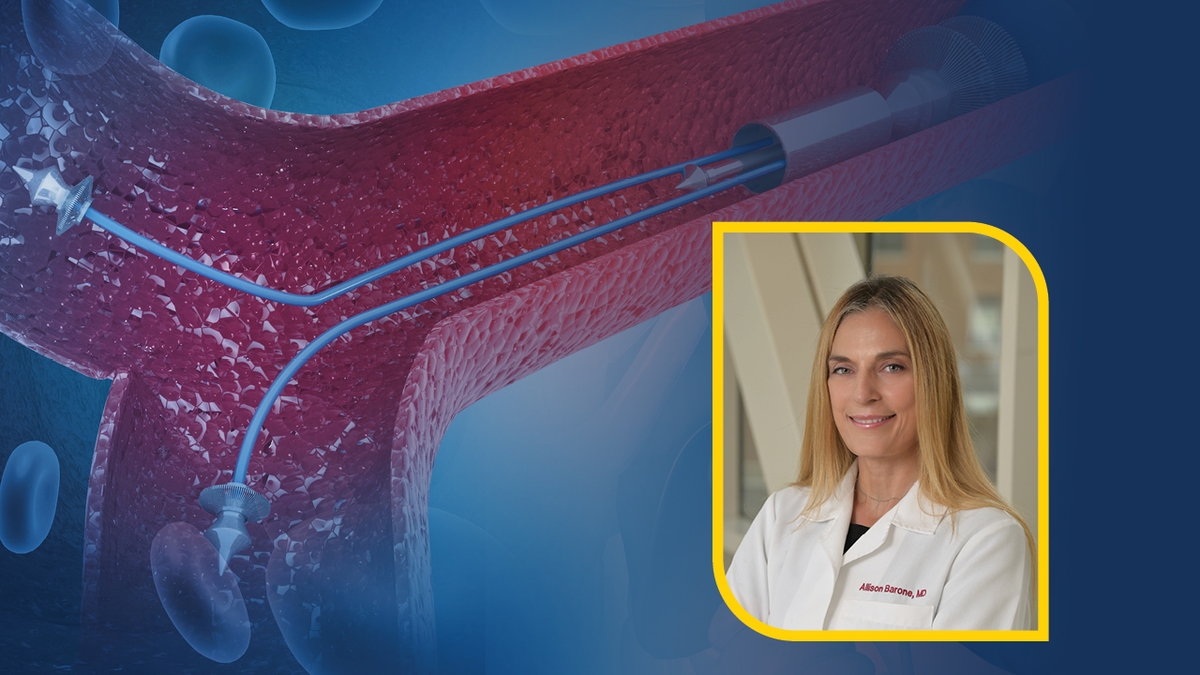
Instead of making large cuts with a scalpel, these doctors use live imaging—such as ultrasounds and real-time X-rays—to see inside you. They also use these live images to guide tiny tools, like thin tubes (catheters) and needles, directly to the problem area through your blood vessels.
Because these procedures only require a tiny nick in the skin, they can be a great alternative to traditional surgery. As a result, patients usually experience:
From destroying tumors to opening blocked arteries, IR doctors can treat almost any part of the body. But how exactly do they protect our body’s most important fluid—our blood?
One of the most important jobs of an IR doctor is to protect a person's natural blood supply. "When it comes to saving a patient’s own blood, IR doctors are the ultimate allies,” explains Allison Barone, MD, a leading IR doctor at Englewood Hospital and recipient of the 2026 Physician of the Year Award. “Because our techniques are so precise, patients lose only a tiny fraction of the blood they would normally lose in regular open surgery."
These doctors save blood in emergencies and routine care in two main ways:
1. Stopping Sudden Bleeding—Fast!
When a patient has severe internal bleeding, such as from a car accident or a torn blood vessel, every second counts. Instead of doing a major surgery just to find the source of the bleed, IR doctors can slide a tiny tube straight to the exact bleeding spot. Once there, they can plug the leak from the inside using tiny coils, foam, or medical glue.
2. Preparing for Cancer Surgery
IR doctors act early to protect a patient's blood during cancer care. Large tumors need a massive network of blood vessels to feed themselves and grow. So, an IR doctor may go in and purposefully block those vessels before a surgeon removes a tumor. This approach dramatically reduces blood loss during the upcoming surgery, keeping the patient's blood levels stable without the use of donor blood.
"It is an honor to support bloodless care at Englewood Health,” notes Dr. Barone. “By working closely with other doctors, we can get the best results for our patients while always respecting their personal choices."
Interventional radiologists bridge the gap between medicine and surgery. They use high-tech tools to solve tough medical problems. By mastering the art of guiding tools via live screens, they do more than treat sickness—they stand as primary guardians of your body's vital life force: your blood.
Published June 2026

For Allison Barone, MD, medicine has always been personal. Inspired early on by a father who began—but could not complete—his own medical journey, Dr. Barone knew from a young age that becoming a physician was her goal.
After earning a medical degree from the Icahn School of Medicine at Mount Sinai, Dr. Barone went on to complete both residency and fellowship training at Mount Sinai Beth Israel, specializing in interventional radiology. Today, board certified in both diagnostic and interventional radiology by the American Board of Radiology, Dr. Barone combines precision imaging with minimally invasive techniques to treat complex conditions.
What makes interventional radiology so compelling? “It’s the combination of hands-on procedures and diagnostic problem-solving,” Dr. Barone explains. “And the field is always evolving. There’s always something new that can help patients in a better, less invasive way.”
When not caring for patients, Dr. Barone enjoys an active life outside the hospital, spending time with two teenage sons, running, swimming, and hiking with the family’s dogs.